


· Micha
How to Find Water in Valencia
Valencia has 832 public drinking fountains. Most of them are green cast-iron pillars with a bearded face, the rest are plain posts and new chilled refill dispensers. What they look like, how they work, and where the faces come from.
It’s really easy to find drinking water in Valencia. Every couple of hundred meters there is a public fountain where you can refill your bottle, in the old town, in the residential streets and all along the park in the old riverbed. If you open droply, you can be sure to find water just a few minutes away. So definitely bring your bottle to Valencia.
Most of the fountains you will see are of the same old model, a green cast-iron pillar with a bearded face. In between you find a newer generation of steel dispensers. Below I show both, how they work and where the face on the old ones comes from.
How many drinking fountains does Valencia have?
Valencia has 832 public drinking fountains, according to the city’s open data on public fountains from February 2026. They are spread over all districts, from the old town to the beach neighborhoods and the outskirts.
On droply you find more than 2,600 water sources in and around Valencia, including the fountains in the neighboring towns and the decorative fountains in the city.
Summary: 832 public fountains, one every couple of hundred meters in most neighborhoods.
The green cast-iron fountain with a face
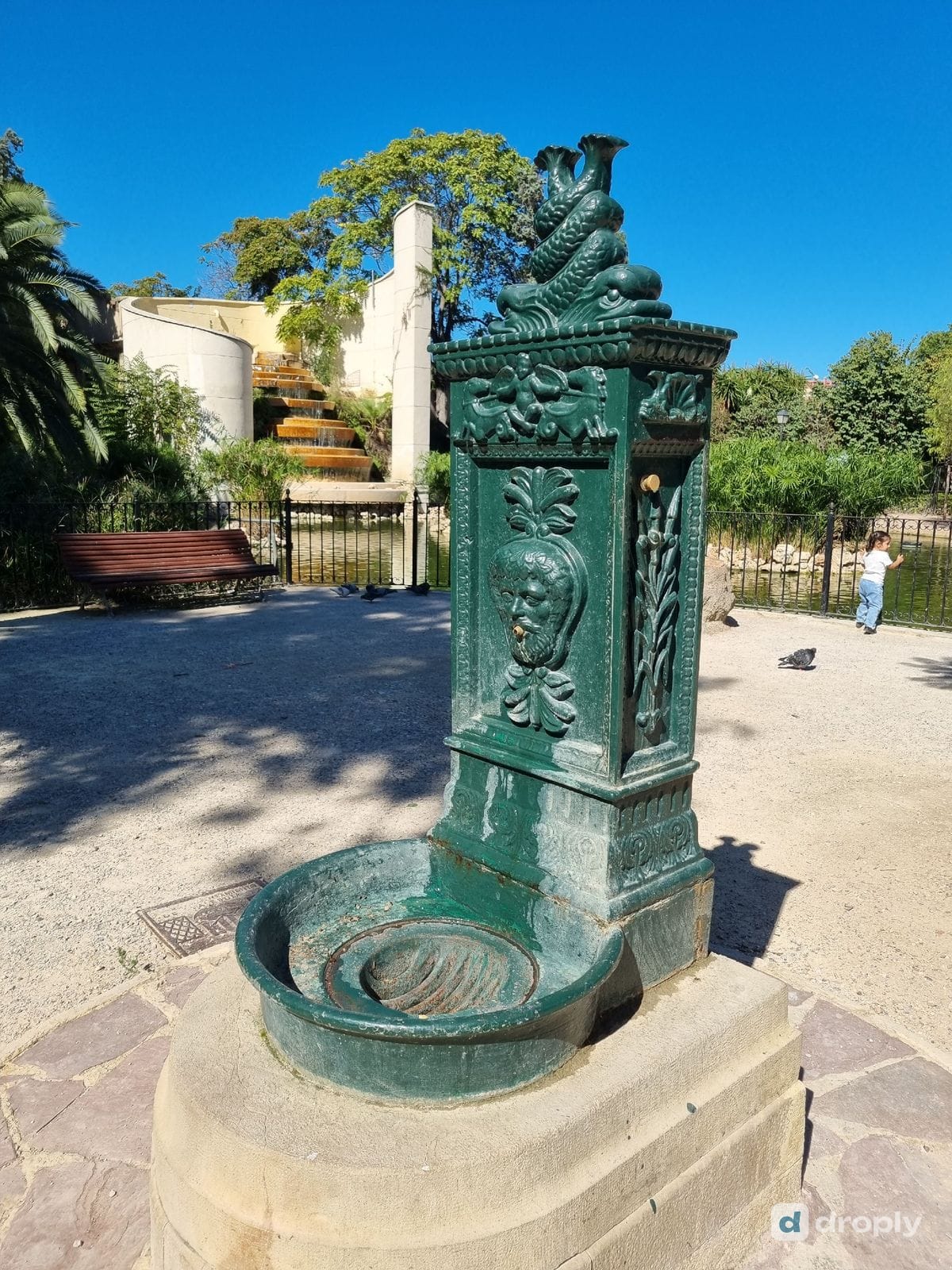
The fountain you will see most often is a green cast-iron pillar, about chest high, on a stone base with a round basin in front. On the front panel is a bearded man’s face with the spout in his mouth. Above the face there is a palmette ornament and a frieze with a small cherub, and on top two dolphins twist around each other with their tails up. On the side there is a brass push button.
Press the button and hold it. The water comes out of the face’s mouth and stops as soon as you let go. The basin has a grate, so the overflow goes directly into the drain.
About four in ten public fountains in Valencia are this model, roughly 330 across the city. Most of the others are simpler green cast-iron posts or plain steel columns. Not all face fountains are green. Some older ones are still painted black or dark grey, with the same face, dolphins and button.
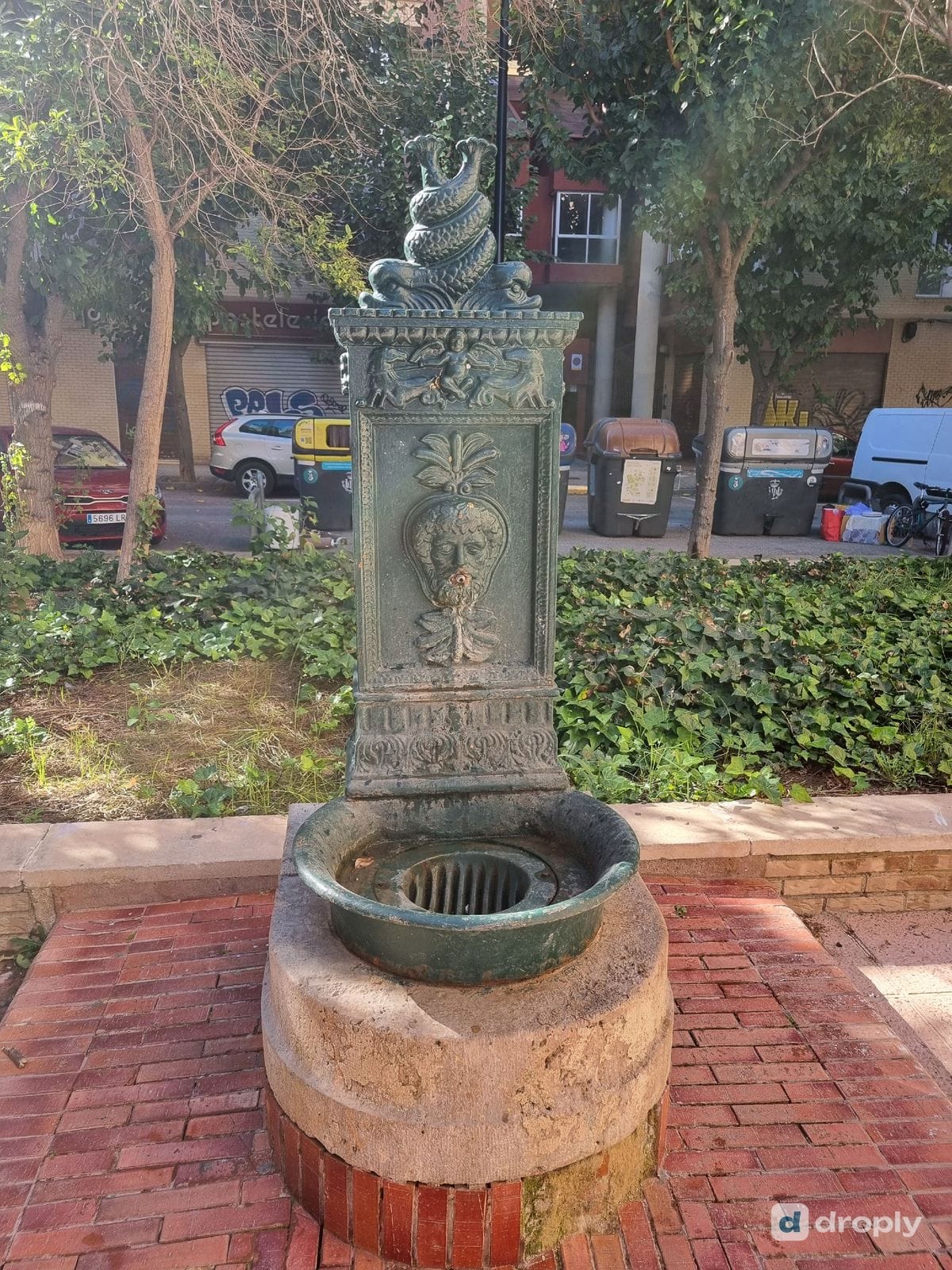
Summary: The green face fountain is Valencia’s standard drinking fountain, about 330 of them across the city. Press the button on the side, and the water comes out of the face’s mouth.
Why do the old fountains have a face?
The sculpted face is called a mascarón in Spanish: a face or mask on a fountain, usually with the water coming out of its mouth. The motif is much older than the fountains. It goes back to classical and later European architecture, where faces decorated walls, pedestals and spouts long before cities had piped water.
In the 19th century the face became part of everyday water supply. Cities built their first drinking water networks, and at the same time French foundries like Val d’Osne, Ducel, Durenne and Tusey made decorative cast iron, the so-called fontes d’art, in series. Cities chose fountains from catalogues, and local foundries soon cast their own versions of the French models, as a study of these foundries in Spain by Daniel Lucas Teijeiro Mosquera shows for Galicia. Because the same mould could be cast again and again, a city could put the same ornate fountain on hundreds of corners. The green paint is a protective coating against rust, it doesn’t tell you where a fountain was made. If you want to know more about one fountain, look for a maker’s plate or a cast inscription at the base.
The Font del Negret: Valencia’s first drinking fountain
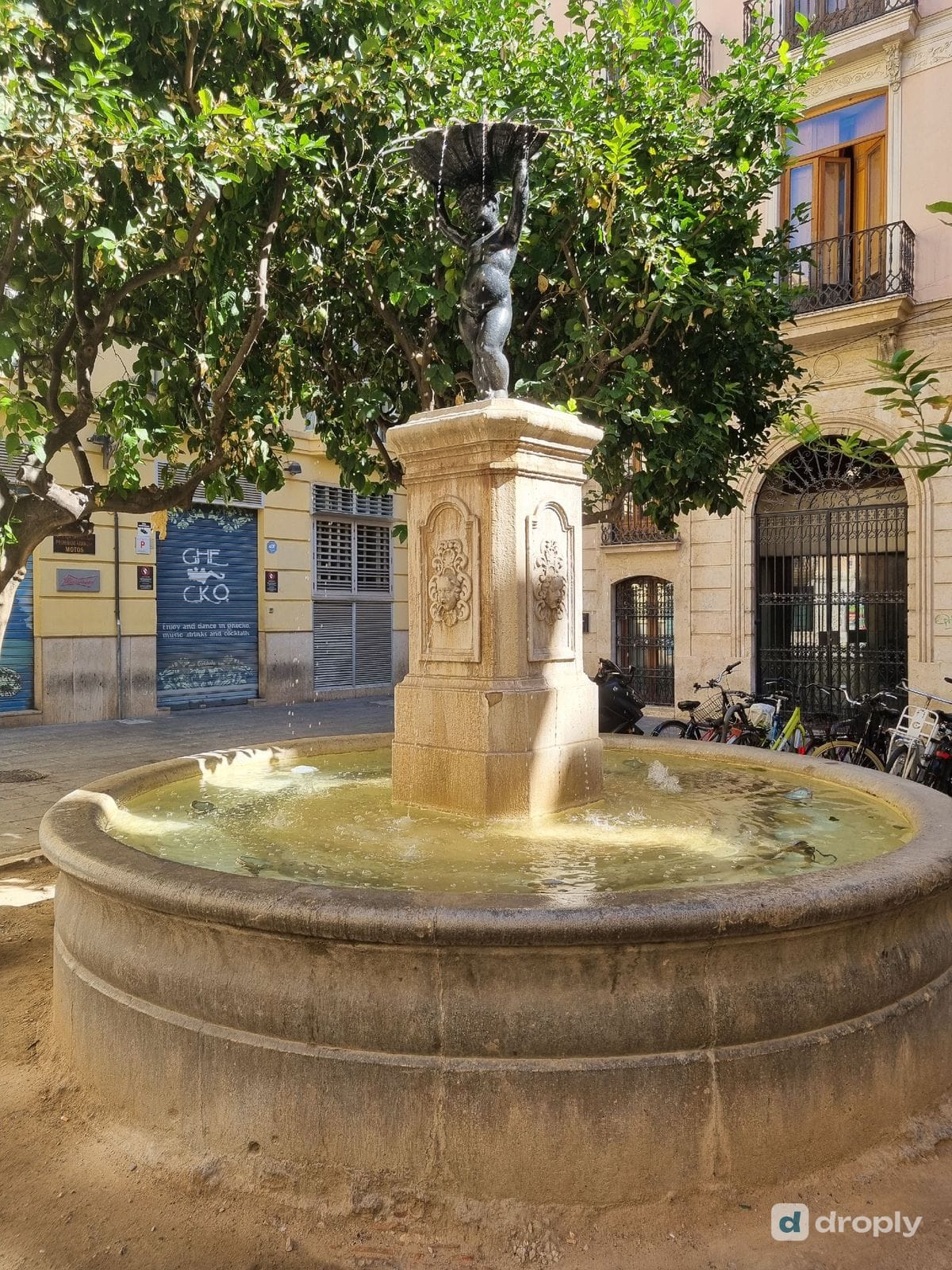
Valencia’s first drinking fountain already had faces. Before 1850 the city got its water from old fountains and wells. Then the canon Mariano Liñán left a large sum in his will to bring drinking water into the city, and on 19 November 1850 the first public drinking fountain opened on what was then Plaza de Calatrava. Its pedestal carries a sculpted face on each side, and on top a dark child figure holds up a shell. Valencians called the child “el Negret”, the little black one, and in 1940 the square was renamed Plaça del Negret after it. The original fountain was cast at the French Val d’Osne foundry. The child figure you see today is a later replacement.
The Turia fountain: the river with a bearded face
Valencia’s best-known bearded face is on a monument. In the Turia fountain on Plaça de la Mare de Déu, a bearded man lies on a pedestal in the middle of a large basin. He is the river Turia, shown the same way as the Nile or the Tiber in ancient sculpture, and he holds a horn of plenty full of fruit for the fertile farmland around the city. Around him stand eight girls with water jugs, one for each of the irrigation channels that take water from the Turia: Benager i Faitanar, Rovella, Favara, Quart, Tormos, Rascanya, Mislata and Mestalla.
The sculptor Manuel Silvestre Montesinos, known as Silvestre de Edeta, made it, and it was inaugurated in 1976. It finishes a tribute to the same canon Liñán who paid for the Negret’s water in 1850. His bust stands in a garden on the same square. The Turia fountain is a monument and not for drinking, but it’s the best place to understand how much the city owes to its river.
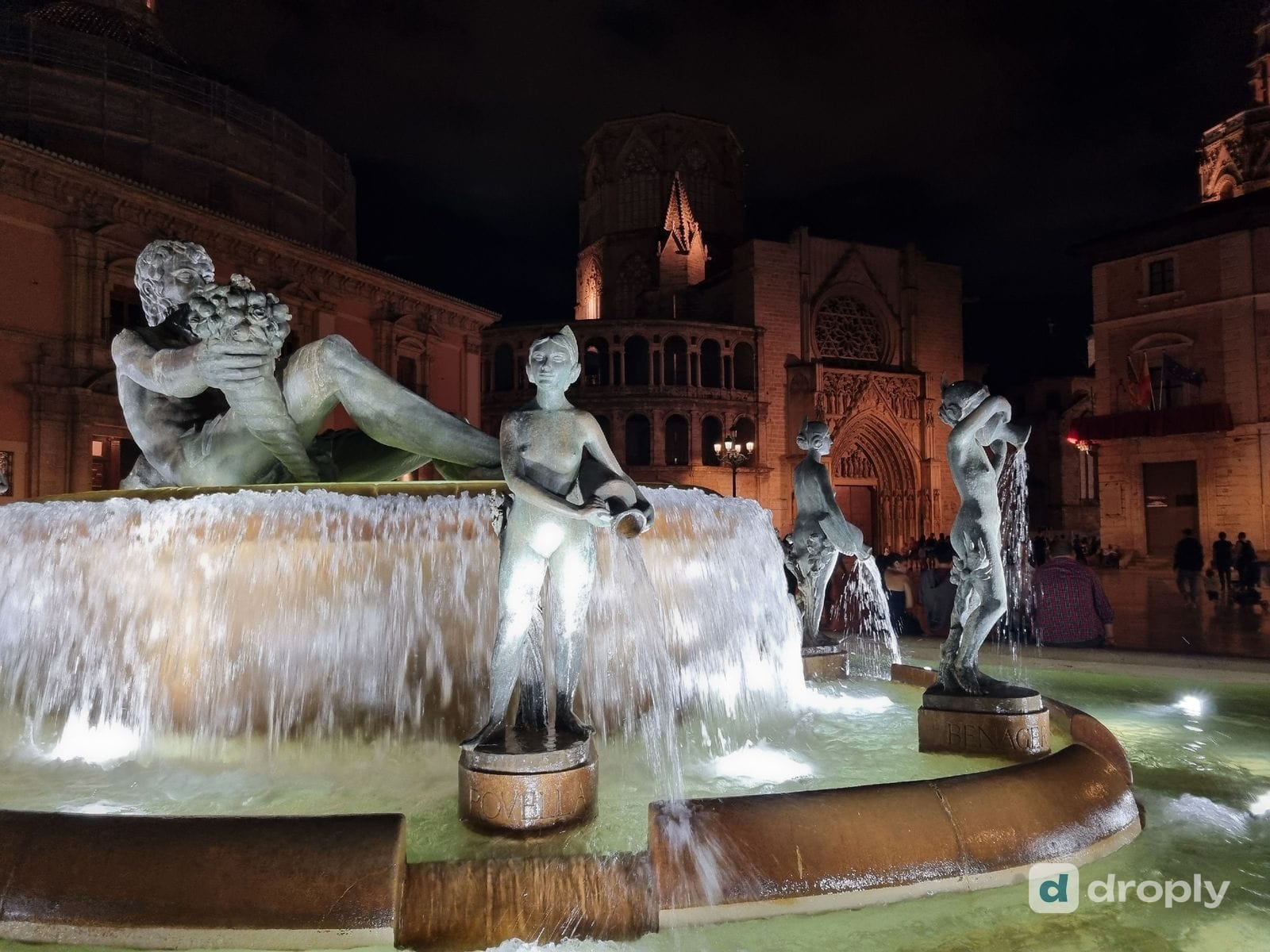
Summary: The face on the street fountains, the mascarón, is an old European motif that 19th-century foundries cast in iron and sold from catalogues. In Valencia you find it on the first drinking fountain from 1850, the Font del Negret, and as a river god on the Turia fountain from 1976.
The new chilled refill dispensers (PUSDAR)
The second generation is a stainless-steel column, about chest high, with a square opening in the middle for your bottle. The city calls them PUSDAR, Puntos de Suministro de Agua Declorada y Atemperada para Relleno de botellas, which means refill points with dechlorinated, temperature-adjusted water. In summer the water comes out chilled.
According to Visit Valencia, the water is filtered twice and disinfected with UV light, and the dispenser cleans itself with ozone after each use. There is no button. The water starts when the bottle is in the opening. Without the chlorine, it tastes softer than at the green fountains.
The first four opened in 2020. In July 2026 there were 77, and the city approved 11 more from its participatory budget, in Sant Llorenç, Malva-rosa, Orriols, Montolivet, Benimaclet and La Saïdia. That is still fewer than one in ten of all public fountains, so most of the time you will use a green one.
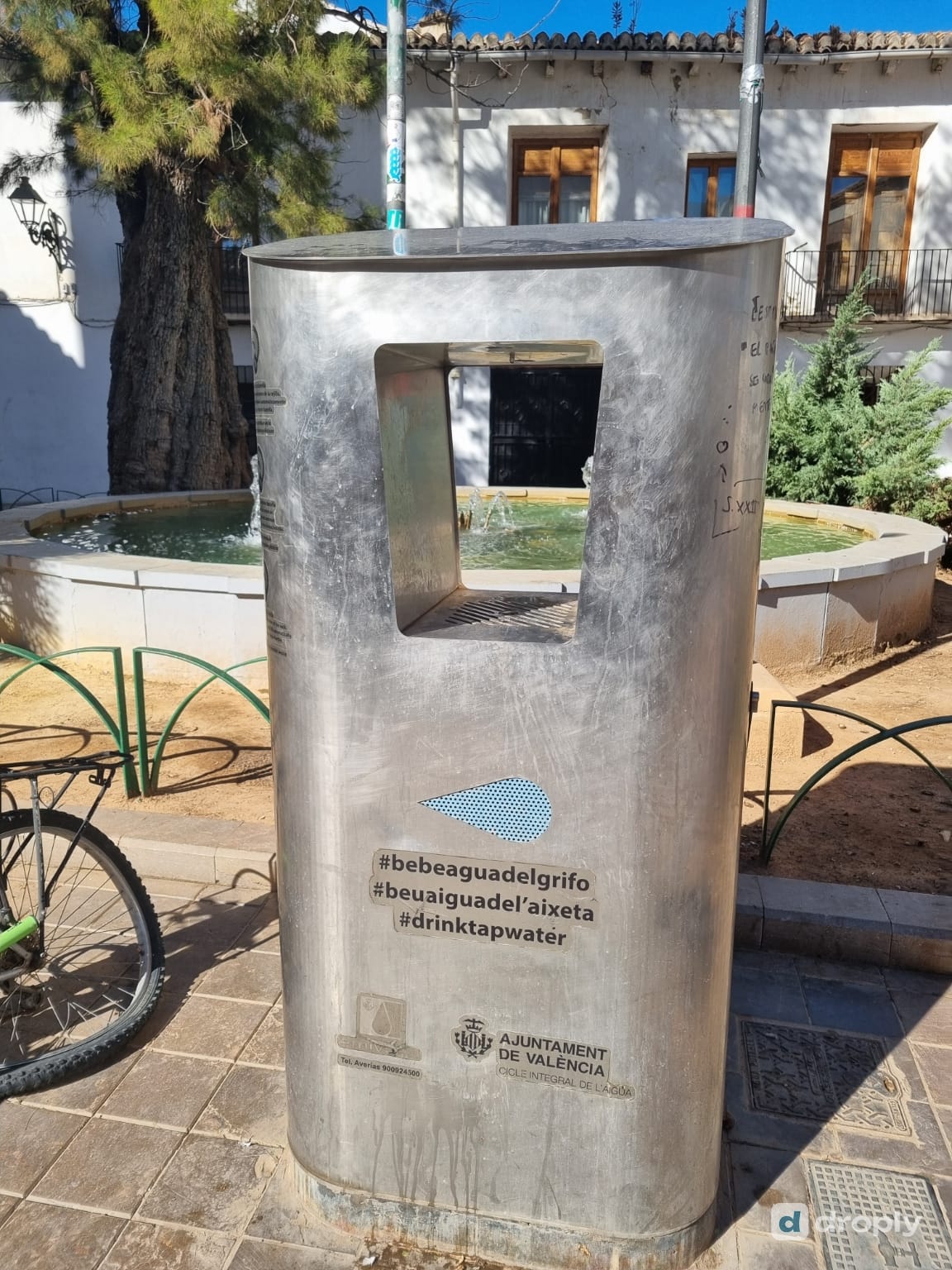
Summary: PUSDAR dispensers are stainless-steel refill points with chilled, dechlorinated water, 77 in July 2026 and 11 more coming. Hold the bottle in the opening, no button needed.
Why are the fountains sometimes hard to find?
They are small and stand wherever there was space: in the corner of a little square, behind parked cars, at the edge of a playground or under a tree in a park. The green paint blends in with the trees and hedges around them. You can walk through a neighborhood with a dozen fountains and not notice one.
Valencia also has many decorative fountains that are not for drinking, like large basins, statues and the ponds in the Turia Garden. If it has a spout or a refill opening, you can drink from it. A basin without a spout is decoration.
That’s why I use droply in Valencia. Open the map and you see the nearest fountain instead of looking around for it. If a fountain is broken or dry, report it in the app, so the next person knows before walking there.
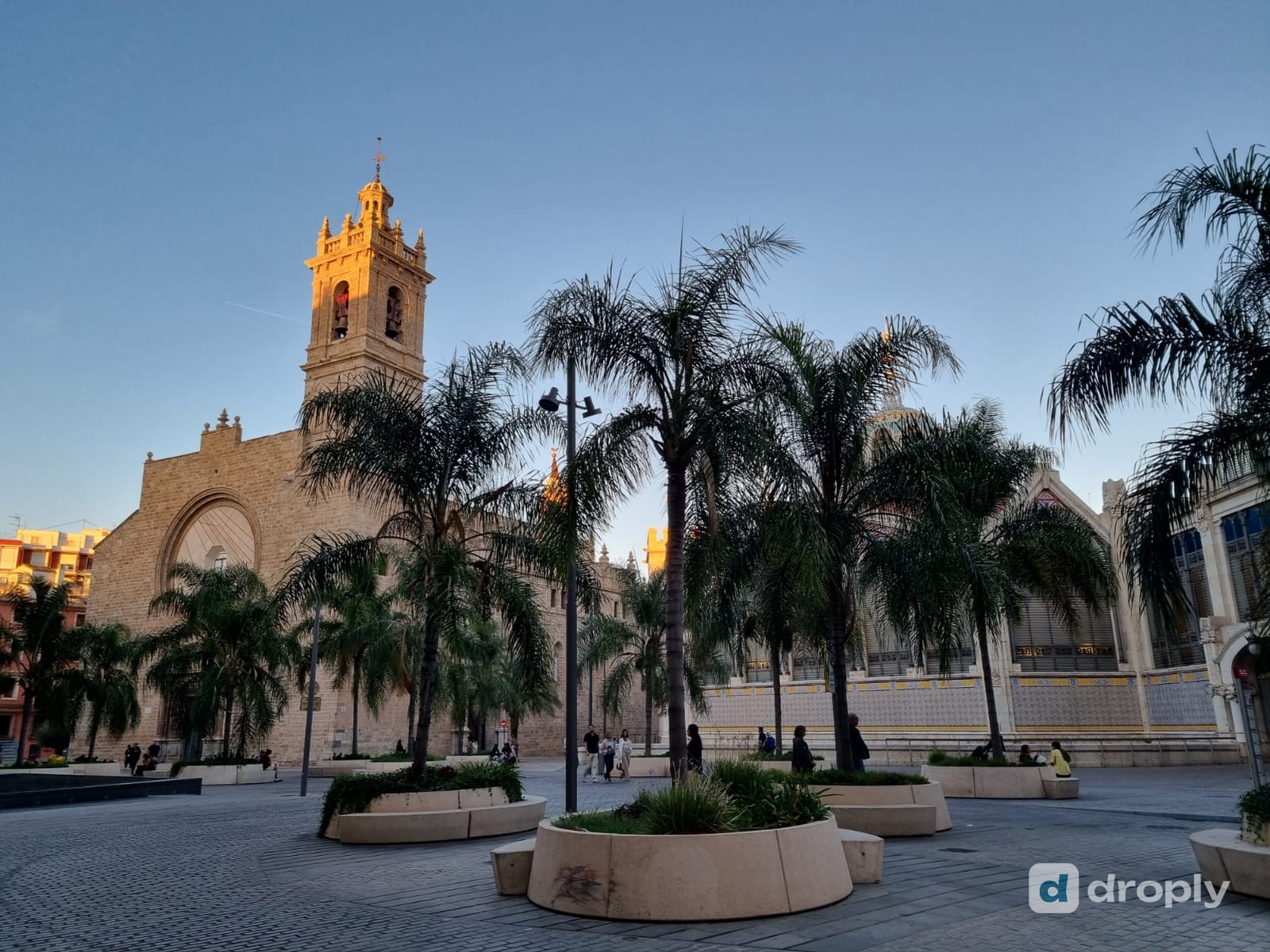
Summary: The fountains are small, green and often in corners, so they’re easy to walk past. droply shows you the nearest one. Look for a spout, not a basin.
Why is Valencia such a green city?
Because Valencia has managed its water for more than a thousand years. The irrigation channels of the Huerta, the farmland around the city, go back to the al-Andalus period, and so does the Water Tribunal, the court that settles disputes between the farmers over water. It still meets every Thursday in front of the Apostles’ door of the cathedral, right next to the Turia fountain, and UNESCO added it to its list of intangible cultural heritage in 2009.
The biggest green space in the city is the result of a flood. On 14 October 1957, the Great Flood of Valencia put large parts of the city under water and killed at least 81 people. In 1958 the government decided the Turia could no longer run through the center. With the Plan Sur, a new riverbed about 12 kilometers long and 175 meters wide was dug south of the city, built for up to 5,000 cubic meters of water per second. Construction ran from 1964 to 1973, El Debate describes it in detail.
The old riverbed through the city was left empty, and the first plan was to build a motorway in it. Valencians protested under the slogan “El riu és nostre i el volem verd”, the river is ours and we want it green. In December 1976 the old riverbed was handed over to the city, and the park opened in 1986. Today the Turia Garden is about 8.5 kilometers long and covers 136 hectares, and more than three million people visit it every year. It’s the easiest long walk, run or bike ride in the city, with drinking fountains along the whole park. The cover photo of this article was taken there.
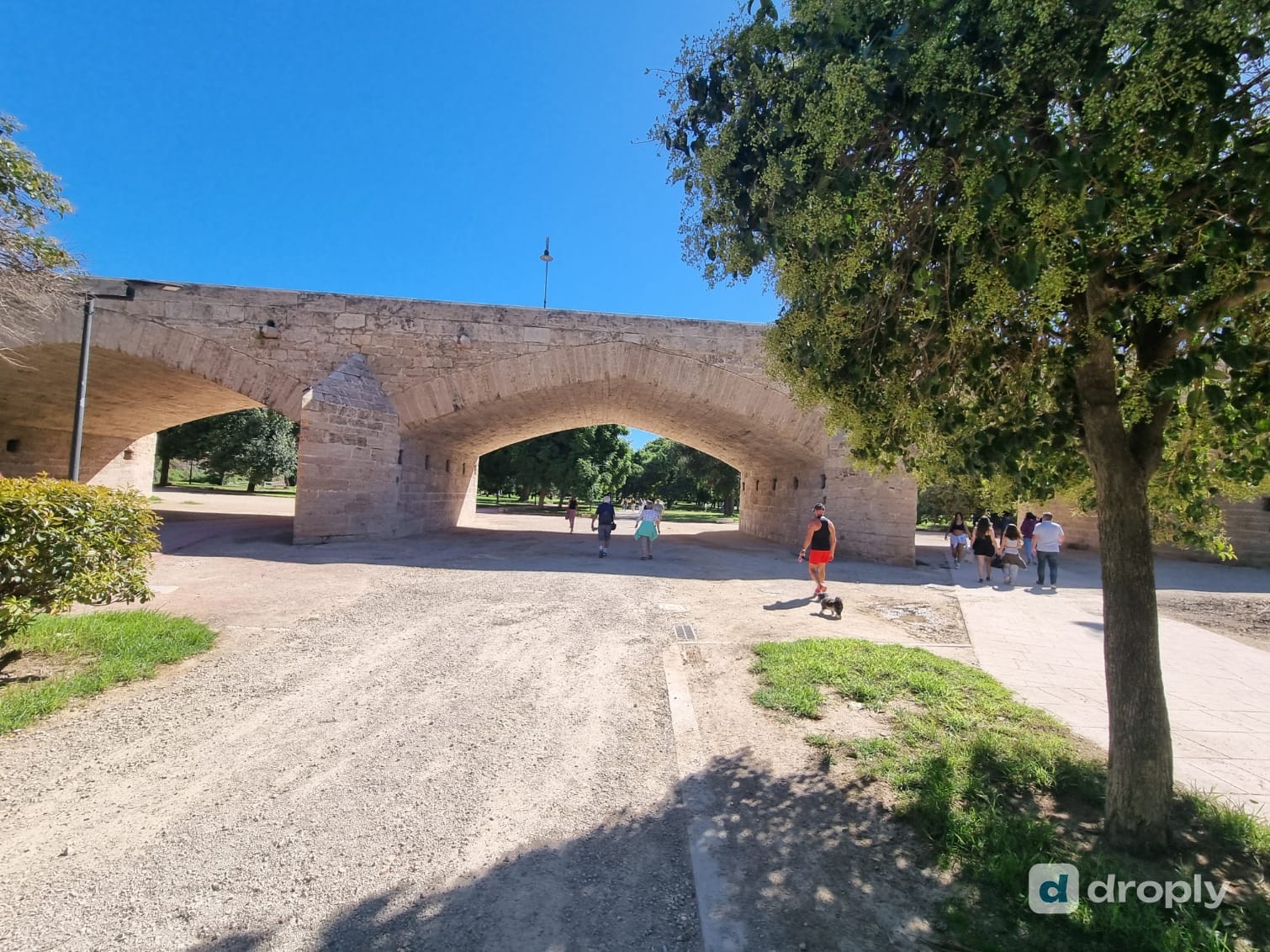
Summary: Valencia’s water history goes back to the irrigation channels and the Water Tribunal of al-Andalus times. After the 1957 flood the Turia was moved south of the city, and the old riverbed became the Turia Garden, 8.5 kilometers of park with drinking fountains along the way.
Is tap water safe to drink in Valencia?
Yes. Valencia’s tap water is treated and checked under the EU drinking water rules, and both the green fountains and the PUSDAR dispensers are connected to the city mains. What many people notice is the chlorine taste. It’s not a safety problem, but it’s the reason the city builds dechlorinating PUSDAR dispensers and prints #bebeaguadelgrifo, “drink tap water”, on them.
If the taste bothers you, fill up at a PUSDAR dispenser when one is close, or leave the bottle open for a while. The chlorine smell fades.
Summary: Tap water and fountain water in Valencia are safe. It can taste of chlorine, the PUSDAR dispensers remove it.
Bring your bottle
With 832 public fountains, a growing number of chilled refill points and a park through the middle of the city with water all along it, you don’t need to buy a single plastic bottle in Valencia. Open droply, find the nearest fountain and refill.
If you find a fountain that isn’t on the map yet, add it with a photo. And if you plan a longer day outside the city, for example upstream along the Turia or to the Albufera, load your route into the droply Navigator to see where you can refill on the way. For how much to carry, see our guide on how much water to carry hiking.
Frequently asked questions
Is it easy to find drinking water in Valencia?
Yes. Valencia has 832 public drinking fountains, spread over every district. In the center and most residential neighborhoods there is one every couple of hundred meters, so you're rarely more than a few minutes' walk from water.
Is tap water safe to drink in Valencia?
Yes. Valencia's tap water is treated and monitored under the EU drinking water rules, and the public fountains are connected to the same mains. Many people find it tastes of chlorine. The newer PUSDAR dispensers remove the chlorine before the water comes out.
What are the green fountains with a face in Valencia?
They are Valencia's classic public drinking fountains: a green cast-iron pillar with a bearded face as the spout, two intertwined dolphins on top and a push button on the side. About four in ten of the city's 832 public fountains are this model. You find them in squares, parks and on street corners all over the city.
Why do old fountains have a face as spout?
The sculpted face, in Spanish a mascarón, is an old motif from European architecture. In the 19th century, when cities built their first piped water networks, foundries cast these faces in iron and sold whole fountain models from catalogues. Valencia's first public drinking fountain, the Font del Negret from 1850, already had faces on its pedestal.
What is a PUSDAR fountain?
PUSDAR is the city's name for its newer refill points: 'Puntos de Suministro de Agua Declorada y Atemperada para Relleno de botellas', points that supply dechlorinated, temperature-adjusted water for refilling bottles. They are stainless-steel columns with a bottle-sized opening. The water is chilled in summer, and you don't need to press anything. Valencia had 77 of them in July 2026, with 11 more approved.
How do the green fountains work?
Press the brass button on the side of the pillar. Water comes out of the face's mouth into the basin below. It stops when you let go, so hold the button with one hand and the bottle with the other.
Can I drink from the Turia fountain in Plaça de la Mare de Déu?
No. The Turia fountain from 1976 is a monument with a bronze river god and eight figures for the irrigation channels, not a drinking fountain. For drinking water, look for a pillar with a spout or a refill dispenser.
How do I find the nearest fountain in Valencia?
Open droply. The map shows more than 2,600 water sources in and around Valencia, so you see the nearest fountain without searching for it. Many fountains stand in a corner of a small square or behind a parked car, and they're easy to miss on foot.
Published on
← Back to blog  By Micha · Co-Founder, droply
CDT thru-hiker (2024) · Co-founder of droply
Micha co-founded droply after thru-hiking the Continental Divide Trail in 2024. A former scout and lifelong outdoor enthusiast, he's always chasing water sources to map: hidden natural springs and hot springs are his favorites.
Get new posts in your reader
New guides and trail notes land in your feed reader the day they're published. No email address, no account, no tracking.
Feed address
https://droply-app.com/rss.xml